
Requires Crowdin account
Website Translator: Translate Website with No Code Changes

Website Translator is a tool that localizes websites with automatic synchronization between your site content and a translation management system. Our app eliminates the need for manual content extraction. This allows you to translate entire websites faster and easier, without the need for technical expertise or code changes.
The Website Translator app seamlessly integrates with leading Digital Experience Platforms (DXPs) and CMS solutions. Easily localize your content across a wide range of supported services, including:
| Service Name | Category |
|---|---|
| UserVoice | Customer Feedback |
| DeveloperHub.io | Documentation |
| Framer | Design & Prototyping |
| Typedream | Website Builder |
| Ghost.org | CMS & Publishing |
| Tumblr | Microblogging |
| Unbounce | Landing Pages |
| Readme.io | API Documentation |
| Pagewiz | Landing Pages |
| Webflow | Website Builder |
| Status.io | Status Pages |
| Squarespace | Website Builder |
| Leadpages | Landing Pages |
| Instapage | Landing Pages |
| Lander | Landing Pages |
| WooCommerce | E-commerce |
| BigCommerce | E-commerce |
| StatusPage.io | Status Pages |
| Tilda | Website Builder |
| Weebly | Website Builder |
Website Translator Overview
Features
- Source and translated content synchronization - Detect, extract, and sync your website content with a Crowdin project
- SEO-friendly translations - Translate meta titles and descriptions
- Scheduled synchronization - Automatic sync and publishing scheduling
- Instant translations - Use machine translation (DeepL) for new content instant translation
- In-context preview - Preview translations on your website
- Application modes - Server-side, client-side, or hybrid scanning
- Advanced filtering - Configure CSS selectors and path filters for precise content control
- Variable patterns - Create reusable translation patterns with placeholders
- Review system - Review and approve new content before translation
This app uses a CDN for translation delivery, which involves additional costs. These charges will be reflected in your Crowdin account based on traffic.
Learn more about CDN Pricing and how to Manage Your CDN Usage.
How the Website Translator Works
- Setup: Input your website URL and translation preferences
- Scanning: The app crawls your website and extracts all translatable texts
- Import: You select pages that are then imported into your Crowdin project as translation files
- Content Translation
- Publishing Translations
- Integration: Add a JavaScript snippet to enable the language switcher for visitors
Translation Configuration
Choose the way to scan your website content:
- Server side (Default): Crowdin crawls your website and looks for new content to translate
- Client side: Untranslated text that is detected when you or your visitors open pages in a target language is sent for translation
- Server & Client side: Combines both methods
If you limit access to your website by IP address, for example on a staging site, add the IP addresses listed under Integrations and Applications to the website's allowlist so Crowdin can crawl it.
CSS Selectors to Ignore
Specify CSS selectors for HTML elements whose content should not be imported. Use IDs (e.g., #header-nav) or classes (e.g., .no-translate), separated with commas.
Paths Filter
Control which pages are crawled. Use pattern matching:
/about- Exact page/about/page/**- All pages starting with/page//article/*- One level above/article//**/comments- Pages that end with/comments!/admin- Excludes the/adminpage
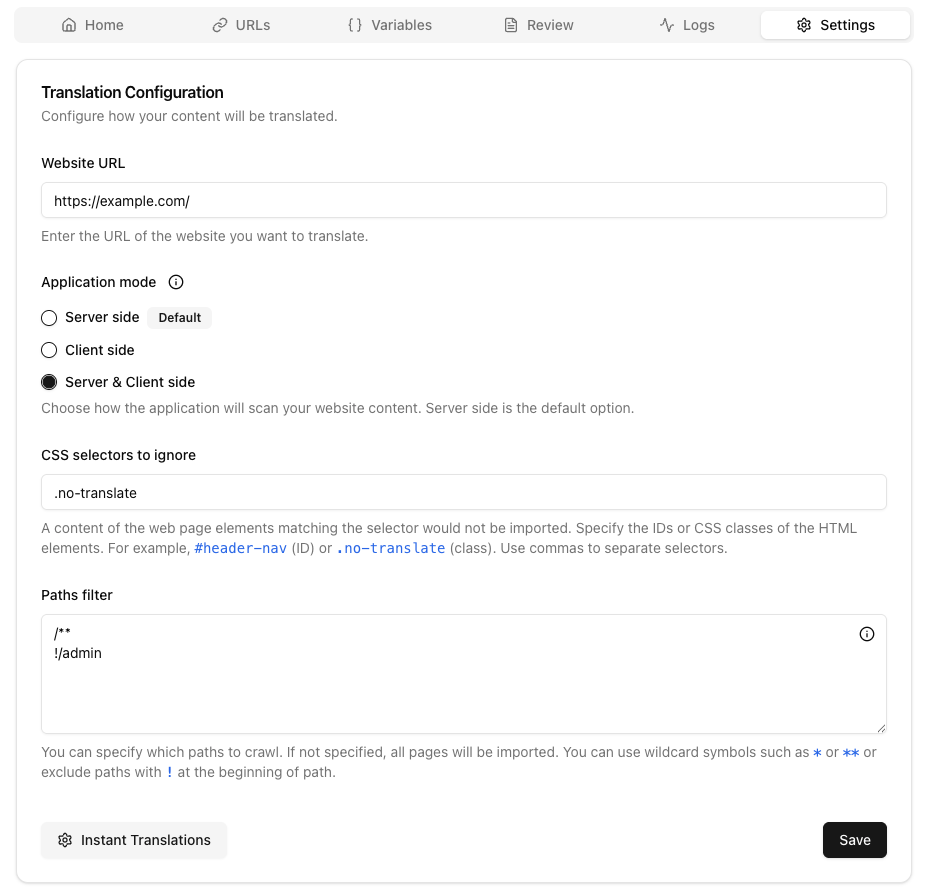
Instant Translations
Set up DeepL API integration for instant translation of new content in client-side mode. This allows users to see translated content before it's imported into Crowdin.
Website Translation Automation
Set up auto synchronization and publishing schedules:
- Source sync schedule: Choose manual, daily, or weekly synchronization
- Publishing schedule: Select to publish manually, hourly, daily, or weekly
Language Routing Method
Choose how languages are specified in your website URLs:
- Query Parameter (
test-site.com?lng=en) - Subdomain (
en.test-site.com) - Subdirectory (
test-site.com/en)
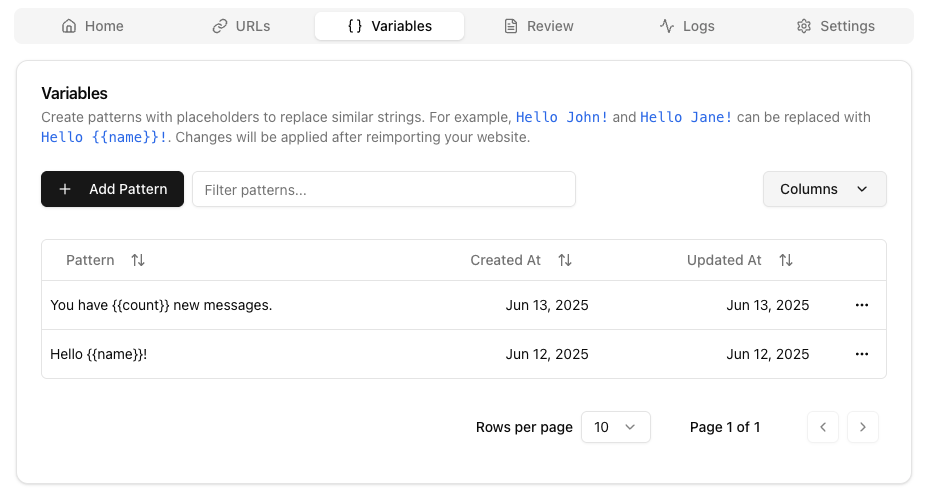
Variables
Create reusable translation patterns with placeholders to replace similar strings. For example, "Hello Antony!" and "Hello Mary!" can be replaced with "Hello {{name}}!". Changes are applied after reimporting your website.
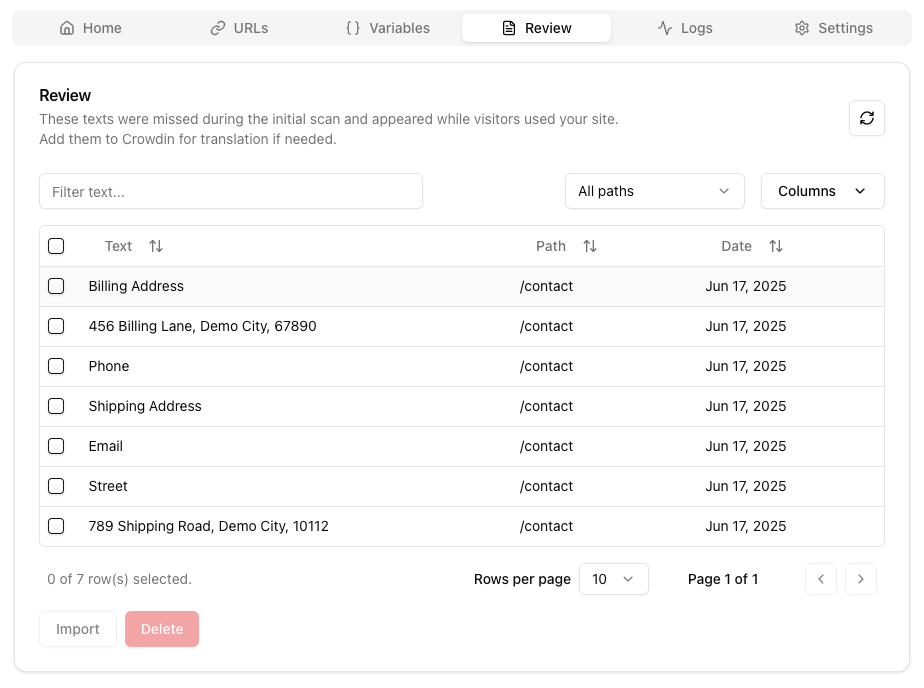
Review Strings
In client-side mode, review and manage texts that were missed during scanning. These appear when visitors use your site and can be imported to Crowdin for translation or deleted if not needed.
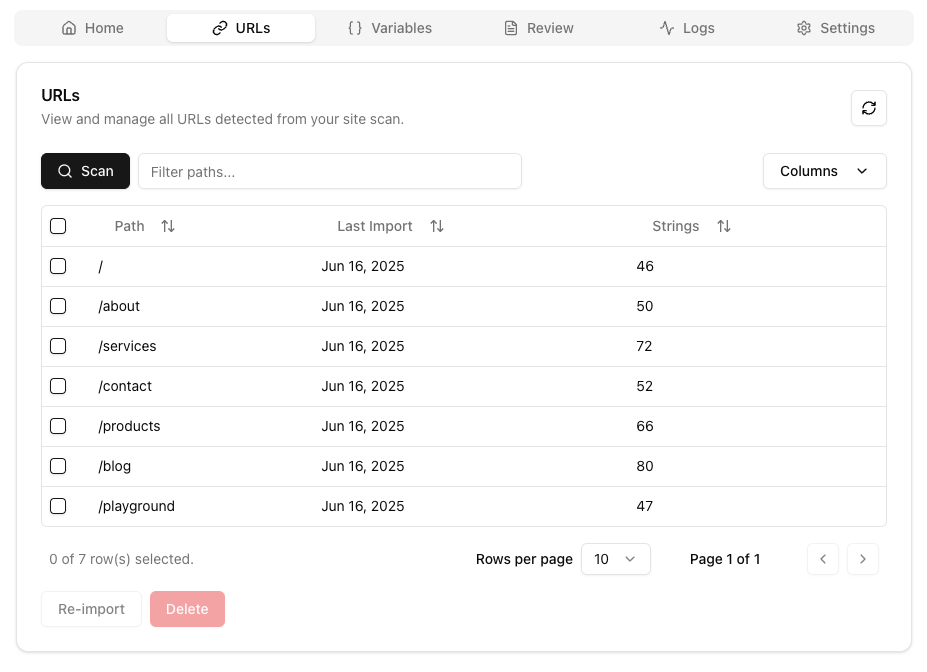
URLs Management
View and manage all URLs that were detected by the scan:
- Scan website - Discover new pages to translate
- Re-import - Update existing pages with new content
- Delete - Remove pages from your Crowdin project
- Filter and sort - Organize pages by path, import date, or string count
Website scanning is limited to a crawl depth of 5. This means the crawler will follow links up to 5 pages deep from your starting URL. Pages beyond this depth threshold won't be discovered during the scanning.
In-Context Preview
Preview translations on your website and see how they look in context. Requirement: enabled in-context translation for your Crowdin project.
Code Snippet
After publishing translations, add this JavaScript snippet to your website to enable the language switcher:
<style>.js-proxy-blur {filter: blur(5px);}</style>
<script>
  // Generated script with your project configuration
  // Includes language switcher and translation functionality
</script>
Also add the js-proxy-blur class to your <body> tag:
<body class="js-proxy-blur">Next Steps
- Choose translation strategy
- Publish translations
- Monitor and maintain
Q&A
Q: Some texts on my website (such as newly added elements, dynamic content, or pop-ups) remain untranslated on the live site, even though the publishing logs show no errors. How can I fix this?
A: This might happen in any application mode when new text appears on your website but hasn't been scanned and imported into your Crowdin project yet. The steps to resolve this depend on the Application mode you are currently using:
If you use Server-side mode:
- Open your Crowdin project and go to the Integrations tab.
- Open the Website Translator app and navigate to the URLs tab.
- Select the pages containing the missing translations and click Re-import. Alternatively, wait for your automated Source sync schedule to run.
- Translate and approve the newly imported strings in your Crowdin project.
- Go to the Home tab and click Publish Now to update your live website's distribution.
If you use Client-side mode:
- Open your Crowdin project and go to the Integrations tab.
- Open the Website Translator app and navigate to the Review tab.
- Select the pending strings (which were detected whenever visitors opened a page with untranslated text) and import them into your project.
- Translate and approve the newly imported strings.
- Return to the Home tab and click Publish Now.
If you use Server & Client-side mode: You can use either of the methods described above, depending on whether the text was crawled by the server or detected by a visitor's browser.
Certain types of text (e.g., dynamic content, pop-ups, or pages hidden behind an authorization or login screen) cannot be reached by the Server-side crawler. To translate these text elements, you must use the Client-side or Server & Client-side mode so the app can detect them as users browse the live site and send them to the Review tab.


Crowdin is a platform that helps you manage and translate content into different languages. Integrate Crowdin with your repo, CMS, or other systems. Source content is always up to date for your translators, and translated content is returned automatically.
Learn More- —Crowdin Enterprise
- —crowdin.com
Released on Jun 17, 2025
Updated on Oct 13, 2026
Published by Crowdin
Identifier:website-translator